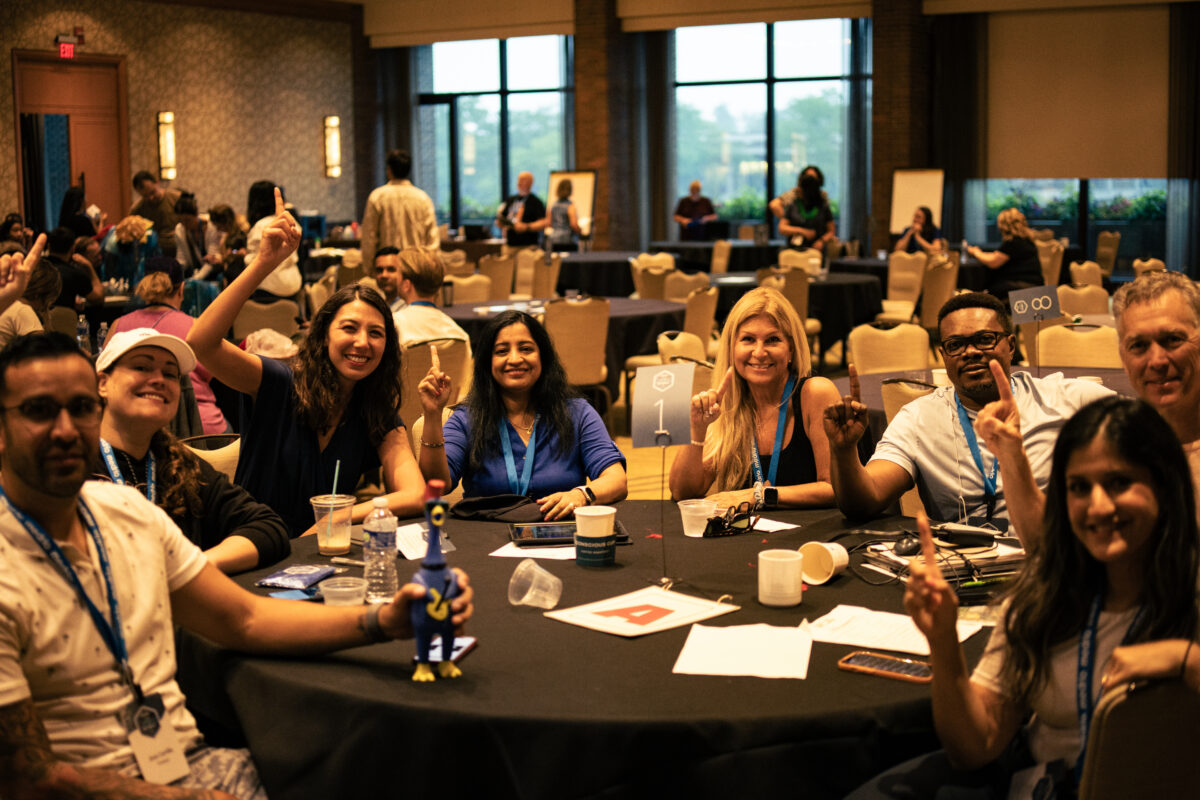
Choosing a team event best-suited for your group is often more than just choosing a fun activity that everyone will enjoy – it’s about aligning the experience with your organization’s strategic goals. Team building events have long been centered around competition, but the landscape is shifting towards more collaborative events to enhance team cohesion, as it is now recognized as a leading factor to company success. So what’s the difference between competitive and collaborative formats? And can we have the best of both worlds?
Defining Competitive vs. Collaborative
Competitive team-building events are ones where the larger group is split into teams that compete against each other in activities and ultimately award a winning team. These events drive energy and engagement, and help break the ice at large conferences and meetings. They are best suited for large groups, when splitting the group into teams means that every attendee has the opportunity to collaborate and have their voice heard. These events are fun, energetic, and especially perfect for types of teams who work in a competitive environment. However, they don’t have to be for everyone.
At a collaborative team-building event, teams work under a shared goal, where success depends on everyone working together. It relies on collective problem-solving, open communication and mutual support. The goal of a collaborative team-building event is to build team cohesion through practicing psychological safety, where attendees are encouraged to safely share ideas and take risks without fear of judgement or penalty. These events are typically best-suited for smaller groups because roles can be clearly defined and responsibilities are sure to not be spread out so thin.
Aligning with Company Culture: Choosing Your Format
When deciding between these two event styles, look closely at your existing company culture and the goals of your meeting or conference. Are your teams primarily motivated by individual rankings, or are your milestones deeply team-based? In a healthy organization, these goals actually work together. Healthy competition and incentives can ignite individual performance, while working toward a common goal keeps the broader organization aligned.
If the goal of your meeting is to energize a large crowd, break the ice, and kick off an event with high enthusiasm, a competitive event is probably right for your group. If your organization is looking to break down departmental silos, build trust, and deepen cross-functional communication, a collaborative event is likely a better fit. It is important to know the general personality types that will be present at your meeting. Sometimes collaborative events can lead to clashes if attendees have different styles of working, or if multiple people have natural leadership skills, or if some may be prone to taking a backseat role and relying on their more outspoken peers. Competitive events, while engaging and fun, can sometimes prioritize speed over connection, and may alienate those who are less motivated by rivalry.
The CEI Hybrid Approach
Because both styles offer unique benefits, and come with their own distinct challenges, we don’t believe you can have the best of both worlds. At Corporate Event Interactive, we specialize in a hybrid model that captures the high-energy engagement of competition while anchoring it in the deep trust of collaboration. By blending these two formats, we appeal to all personality types, keeping your natural leaders, analytical thinkers, and introverted team members equally motivated and engaged.
Our events are designed with a collaborative macro-goal, but a competitive micro-execution. For example, in our Corporate Social Responsibility (CSR) events, the overarching goal is entirely collaborative: the whole room must unite to pack as many donation kits as possible for a local charity. Similarly, in our themed game shows, the ultimate objective might be for the entire group to successfully escape an “island.” To supercharge the energy in the room, we introduce a friendly, competitive edge by having smaller teams race against each other.
This structure balances short-term excitement with long-term strategic value. The fast-paced competition drives immediate engagement, breaks the ice, and keeps energy levels soaring. At the exact same time, the only way for any individual team to succeed in the competition is to master internal collaboration. By designing events where the micro-competition serves the macro-collaboration, we deliver an experience that feels like a game, but builds the psychological safety and communication skills your team needs for the long haul.